
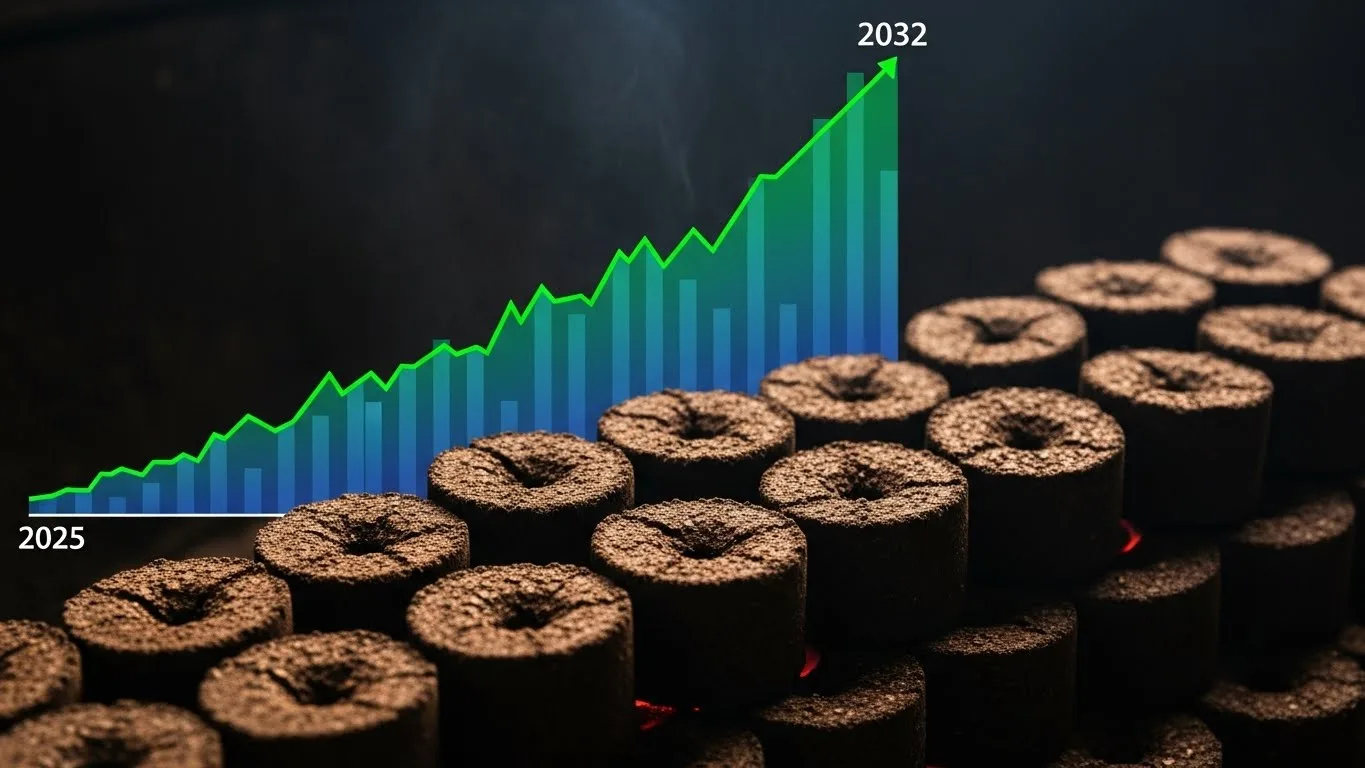
The global coconut charcoal market is set for strong growth between 2025 and 2032, driven by rising demand for eco‑friendly fuels, natural hookah charcoal, and high‑performance briquettes for BBQ, shisha, and filtration. Market studies estimate that coconut charcoal could roughly double in value over this period, with many forecasts pointing to solid mid‑ to high‑single‑digit annual growth worldwide.
Market size and growth outlook (2025–2032)
Recent market reports suggest the global coconut charcoal market is worth several hundred million to over one billion USD in the mid‑2020s and is projected to pass the 1–3 billion USD range by 2032, depending on the segment and methodology. One forecast, for example, estimates the coconut charcoal market at about 632.8 million USD in 2025, reaching around 1.12 billion USD by 2032 (about 7.5% CAGR), while another report for broader coconut charcoal applications expects growth from roughly 1.75 billion USD in 2024 to 3.65 billion USD by 2032 (around 9–10% CAGR). A focused briquettes report also shows coconut charcoal briquettes rising from about 8.5 billion USD in 2023 to around 14.7 billion USD by 2032, at about 6.3% CAGR, highlighting how big and fragmented this space already is.
Key demand drivers
For everyday buyers, three simple forces are pushing coconut charcoal demand up.
Eco‑friendly fuel: More people and restaurants want sustainable, low‑smoke charcoal instead of wood‑based or fossil‑fuel‑heavy options, and coconut shells are a renewable by‑product of the coconut industry.
Hookah and shisha: The hookah charcoal market itself is growing at around 6–8% per year, and brands are shifting towards natural coconut shell charcoal that burns longer, cleaner, and produces less ash.
Versatile use: Coconut charcoal is not just for BBQ and shisha; activated coconut carbon is widely used in water filters, air purifiers, and even some cosmetic and wellness products.
This mix of lifestyle trends (BBQ, cafés, lounges) plus “green” and health‑conscious marketing is keeping demand strong across regions.
Main applications and product types
From a shopper’s point of view, coconut charcoal shows up in a few familiar forms.
Briquettes for BBQ and grilling: These are pressed blocks designed to burn hot and steady with minimal smoke and ash. They are popular for outdoor cooking because they are easier to control than lump charcoal.
Hookah/shisha charcoal: Typically cube or flat (flat‑sided) briquettes that heat the bowl evenly, with neutral taste and no quick‑light chemicals. Products like Coco Java Natural Coconut Hookah Charcoal Flats and Cubes are good examples designed for smoother sessions and stable heat.
Activated carbon: Highly porous coconut charcoal used in water and air filtration systems to trap impurities, heavy metals, and odors, which creates a separate but fast‑growing technical market.
For hookah users specifically, coconut flats and cubes give different heat profiles: flats are often preferred for finer heat control, while cubes are popular for longer, hotter sessions with fewer coal changes.
Regional trends and leading markets
Reports point to Asia‑Pacific as one of the leading regions, thanks to strong coconut production (Indonesia, Philippines, India) and large domestic and export‑oriented charcoal industries. Europe, the Middle East, and North America are major demand hubs, with Europe and the Middle East buying a lot of shisha coal and eco‑friendly BBQ charcoal, while North America’s demand is heavily driven by premium BBQ culture and home water filtration. Many Indonesian and Southeast Asian producers focus on export markets, with container loads of briquettes shipped to the EU, Gulf countries, and the US.
Market segments in simple terms
| Segment | What it means | Growth story |
|---|---|---|
| Coconut shell charcoal | Raw or semi‑processed charcoal from coconut shells used for briquettes and activated carbon | Grows with availability of coconut shells and demand for sustainable fuel and filtration media |
| Coconut charcoal briquettes | Shaped blocks for BBQ, grilling, and shisha | Riding the trend toward clean‑burning, long‑lasting, low‑ash fuel |
| Hookah charcoal (coconut‑based) | Flats and cubes for waterpipe and shisha use | Benefiting from the shift from quick‑light tablets to natural coconut briquettes |
| Activated coconut carbon | High‑surface‑area charcoal for filters and industrial use | Supported by stricter water and air quality standards and “clean living” products |
This structure means that even if one segment slows down (for example, hookah due to regulation), other segments like filtration and BBQ can keep overall coconut charcoal demand rising.
Trends shaping the future
A few simple but powerful trends are shaping the 2025–2032 outlook.
Shift to natural and chemical‑free: Hookah and BBQ users increasingly avoid quick‑light coals with strong odors and prefer natural coconut briquettes that are marketed as odorless, low‑smoke, and “no toxic chemicals”.
Sustainability and waste‑to‑value: Using coconut shells (a by‑product that might otherwise be wasted) fits perfectly with circular‑economy and ESG stories, which makes coconut charcoal attractive to importers and retailers.
Online retail and branding: Online platforms make it easy for small and mid‑size brands to reach global customers, and strong branding around “premium,” “long‑lasting,” and “eco‑friendly” is becoming a key differentiator.
At the same time, stricter rules on emissions, deforestation, and tobacco‑related products can create both challenges and opportunities, pushing producers to improve quality and certification.
What this means for everyday buyers
For normal store customers, the global growth of coconut charcoal simply means more choice and better quality products on the shelf. You can expect:
More brands of coconut briquettes for BBQ and shisha, with different shapes (cubes, flats, hexagonal) and burn times.
More clearly labeled “natural coconut hookah charcoal” products, like Coco Java flats and cubes, that focus on even heat, low ash, and no quick‑light chemicals – making them a popular pick for regular hookah sessions.
A steady shift away from dusty, smoky traditional charcoal toward cleaner, better‑packed briquettes that are easier to handle and store.
Because competition is increasing, buyers are likely to see better pricing, more stable quality, and more detailed information on packaging (origin, burn time, moisture, certifications).
)
No comment